The Word for World Is Forest
About the Book
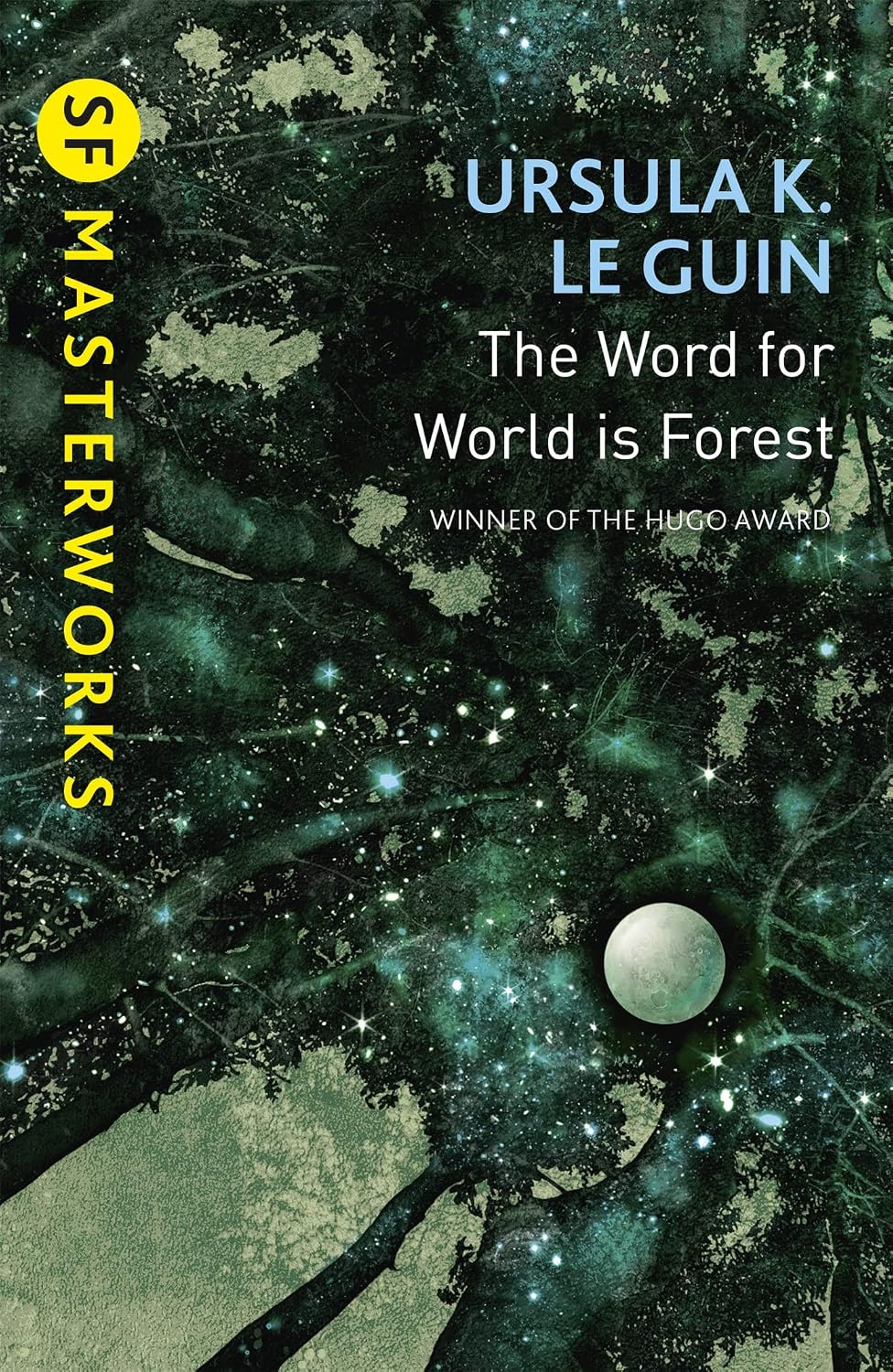
The Word for World Is Forest is a science fiction novel by American writer Ursula K. Le Guin, first published in 1972. The story focuses on a military logging colony set up on the fictional planet of Athshe by people from Earth (referred to as “Terra”). The colonists have enslaved the completely non-aggressive native Athsheans, and treat them very harshly. Eventually, one of the natives, whose wife was raped and killed by a Terran military captain, leads a revolt against the Terrans, and succeeds in getting them to leave the planet. However, in the process their own peaceful culture is introduced to mass violence for the first time.
The novel carries strongly anti-colonial and anti-militaristic overtones, driven partly by Le Guin’s negative reaction to the Vietnam War. It also explores themes of sensitivity to the environment, and of connections between language and culture. The novel won the Hugo Award in 1973, where it had been in the category “Novella”.
(https://en.wikipedia.org/wiki/The_Word_for_World_Is_Forest)
Review
This Science Fiction novella explores several sociological ideas with some very powerful writing. The most obvious idea in the book is about colonialism, war, extermination, and genocide, with many parallels to human history. This idea is largely embodied by a one-dimensional caricatured Army officer, whose thoughts about planet taming strike like a whiplash with its ferocious brutality and cold-blooded arrogance. The idea of inter-racial violence is complemented by ideas about ecological violence. Earth has no forests left and hardly any trees or large animals, making wood a very very important resource for Earth; military logging is the profit motive. This contrasts with the new planet where the entire world is the forest and the natives live in harmony with the forest. For the natives, their word for “forest” and “world” is the same, and “the substance of their world was not earth, but forest”. There are also the ideas of friendship and loyalty, dreaming without sleeping, and messiahs who interpret dreams (Q. Are these interpretations biased? Does the protagonist interpret the dreams as a signal to attack the invaders, because of personal injuries?).
But the most important theme is about non-violence and its two-way impact on the colonization of a pacifist culture: how does non-violence impact colonization and how does colonization impact non-violence. The invaders are violent human beings while the people being invaded are a peaceful non-violent group who have never known murder. To save themselves, they are forced to murder, to learn to kill, to perpetrate mass violence. How much does this contact change their culture? The native American population was decimated by viruses introduced by European settlers. But, the Athsheans are introduced to a mental virus, the idea of murder for both gain and without reason; how will this affect their cultural evolution and survival?
This is also a deeply moving and hard-hitting book that masterfully conveys both power and resistance. But it also suffers from stereotypical and one-dimensional portrayals of situations, and characters tend to be one-dimensional, so that the book has clearly delineated good and evil, with no room for grey shades.
Selected Interesting Ideas in the Book
-
But then Earth was a tamed planet and New Tahiti wasn’t. That’s what he was here for: to tame it. If Dump Island was just rocks and gullies now, then scratch it; start over on a new island and do better. Can’t keep us down, we’re Men. You’ll learn what that means pretty soon, you godforsaken damn planet, Davidson thought, and he grinned a little in the darkness of the hut, for he liked challenges.
-
No way was clear, no light unbroken, in the forest. Into wind, water, sunlight, starlight, there always entered leaf and branch, bole and root, the shadowy, the complex. Little paths ran under the branches, around the boles, over the roots; they did not go straight, but yielded to every obstacle, devious as nerves. The ground was not dry and solid but damp and rather springy, product of the collaboration of living things with the long, elaborate death of leaves and trees; and from that rich graveyard grew ninety-foot trees, and tiny mushrooms that sprouted in circles half an inch across. The smell of the air was subtle, various, and sweet. The view was never long, unless looking up through the branches you caught sight of the stars.
-
“And all men’s dreams,” said Coro Mena, cross-legged in shadow, “will be changed. They will never be the same again. I shall never walk again that path I came with you yesterday, the way up from the willow grove that I’ve walked on all my life. It is changed. You have walked on it and it is utterly changed. Before this day the thing we had to do was the right thing to do; the way we had to go was the right way and led us home. Where is our home now? For you’ve done what you had to do, and it was not right. You have killed men.”
-
“What is, is. There is no use pretending, now, that we do not know how to kill one another.” […] “Maybe after I die people will be as they were before I was born, and before you came. But I do not think they will.”